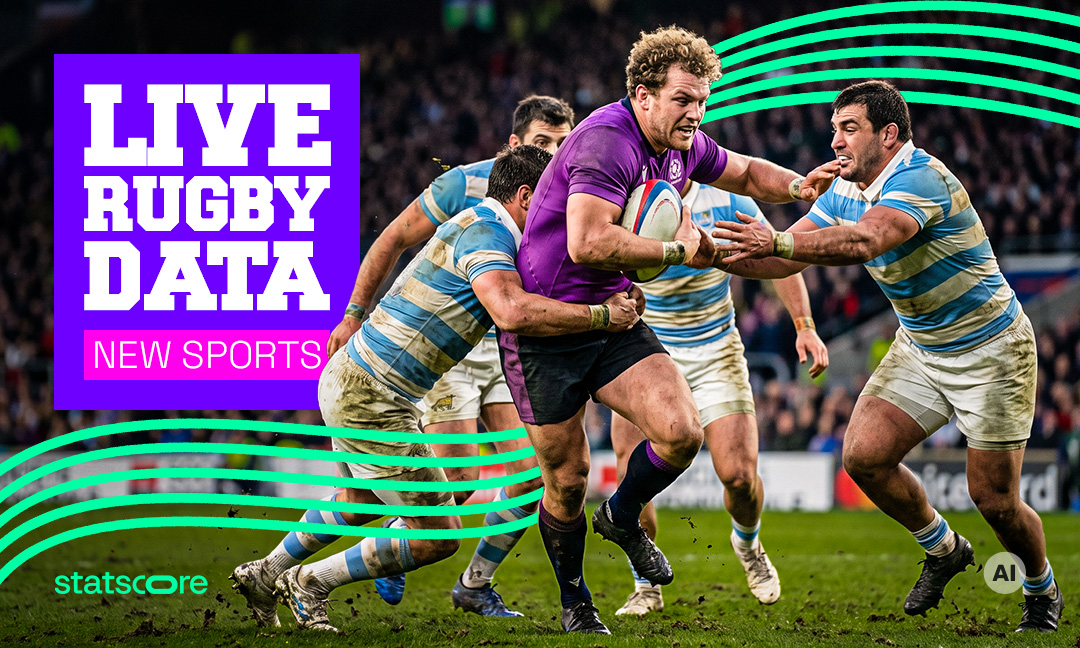









To an outsider, Rugby Union and Rugby League can look almost identical: an oval ball, heavy collisions, lung-busting carries, and H-shaped goalposts. Yet, beneath the shared heritage lie two distinct sporting cultures shaped by fundamentally different rules, pacing, and tactics.
For broadcasters, media, and sportsbooks, treating both disciplines as a single entity simply doesn’t work.
Delivering compelling fan experience requires an intimate grasp of how the two codes diverge, and a data architecture capable of tracking both down to the second.
Here is a breakdown of the core differences between Rugby Union and Rugby League, and how advanced sports tech solutions bring both codes to life in real time.

The Historical Split: Amateurs vs. Professionals
The division between Union and League is one of the most famous schisms in sporting history.
In 1895, 22 clubs gathered at the George Hotel in Huddersfield, England, to break away from the Rugby Football Union (RFU). The issue was broken-time payments: working-class clubs in the North of England wanted to compensate players for missing wage-earning work shifts. The RFU refused, guarding rugby’s strict amateur status.
That rebellion created the Northern Rugby Football Union, which was later renamed Rugby League.
To make the game more attractive to spectators, League altered the rules to emphasize speed, open running, and fewer stoppages. Meanwhile, Rugby Union stayed strictly amateur for another century, formally going professional only in 1995.
Core Differences: How the Two Games Actually Work
While both sports share the objective of grounding the ball in the in-goal area for a try or kicking it over the crossbar, the mechanics of play are completely different.
Team Size and Pitch Space
- Rugby Union: 15 players per side (plus 8 substitutes). With 30 players congested across the pitch, open space is scarce, making territorial kicking and set-piece domination critical.
- Rugby League: 13 players per side (with a smaller bench and limited interchange rules). With four fewer players on the field, there is significantly more room for line-breaks, dynamic footwork, and expansive running.
Possession and Breakdowns: Rucks vs. The Six-Tackle Rule
- Union (Contestable Breakdowns): When an attacking player is tackled, a ruck forms. The breakdown remains contestable: defending players on their feet can legally counter-ruck or jackal over the ball to force a turnover or penalty. Possession can theoretically last indefinitely as long as the attacking side recycles cleanly.
- League (Structured Possession Sets): League removed rucks entirely. When a ball-carrier is brought to ground, they simply roll the ball backwards with their foot (a play-the-ball), while the defensive line must retreat 10 meters. However, the attacking team only has six tackles to score. If they fail to breach the defense on tackle five, they usually opt for a tactical kick; otherwise, a turnover is awarded on tackle six.
Set Pieces: Battles of Strength vs. Formal Restarts
- Scrums:
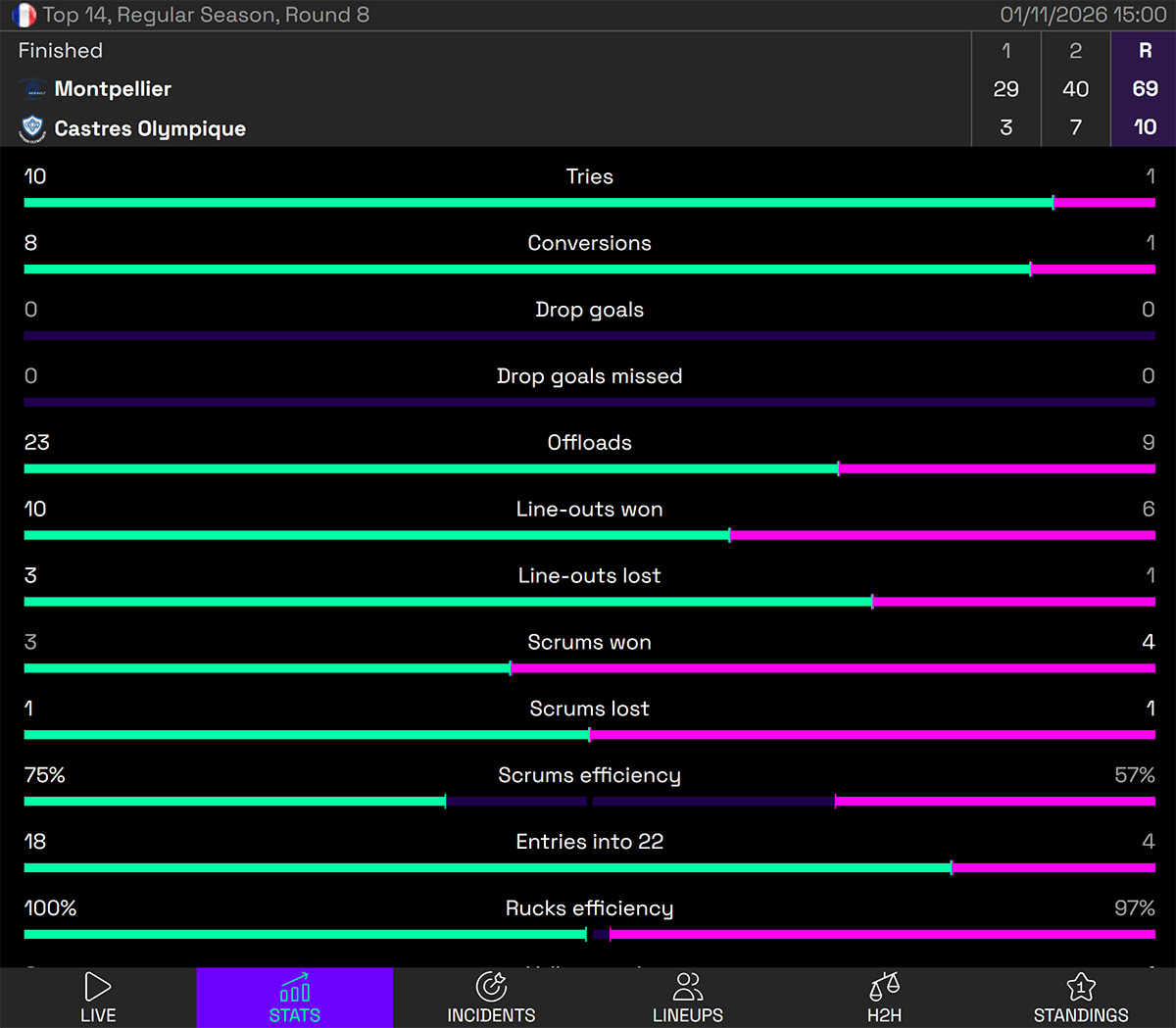
- In Union, the scrum is an eight-man, physically punishing contest of raw power, leverage, and technical dark arts—frequently yielding penalties that decide matches.
- In League, scrums consist of six players and are largely uncontested, functioning primarily as a mechanism to tie up the forwards and free up space for backline play.
- Lineouts:
- In Union, when the ball crosses the touchline, play restarts with a dynamic lineout featuring jumpers lifted into the air and driving mauls.
- In League, lineouts were abolished; play simply restarts with a tap or scrum.
Scoring Dynamics
| Metric | Rugby Union | Rugby League |
| Try | 5 points | 4 points |
| Conversion | 2 points | 2 points |
| Penalty Kick | 3 points | 2 points |
| Drop Goal / Field Goal | 3 points | 1 point (2 points outside 40m in NRL) |
In Union, a penalty kick is worth over half a try, incentivizing teams to play for territory and force defensive infractions. In League, tries dominate the scoreboard, maintaining a relentless focus on attacking momentum.
Why One Rule Set Doesn’t Fit All
For sports media platforms, sportsbooks, and fantasy leagues, rugby poses a unique tracking challenge.
You cannot simply shoehorn a generic “rugby” model into both codes without missing the nuances that fans care about.
- A Union fan wants to monitor breakdown penalties, lineout success percentages, driving mauls, and scrum infringements.
- A League supporter is watching tackle counts (e.g. Tackle 4 – kick incoming?), defensive line retreat discipline, and tactical kicks like the 40/20 (a kick from behind a team’s own 40m line bouncing into touch inside the opponent’s 20m line, turning over possession).
How STATSCORE Powers Both Codes
Recognizing these fundamental differences, STATSCORE has fully tailored its live sports intelligence suite, covering major competitions including the Gallagher Premiership and Top 14 (Union), as well as the NRL and Super League (League).
Rather than forcing both codes into an identical template, STATSCORE built dedicated data architectures across its product ecosystem:
1. Distinct Rule-Set Modeling in ScoutsFeed
Through ScoutsFeed, STATSCORE delivers ultra-fast, low-latency raw data streams directly from stadiums and broadcast desks. The engine accounts natively for the mechanics of each code:
- Union Tracking: Pinpoints scrums, lineout takes, driving mauls, breakdown penalties, conversions, and drop goals.
- League Tracking: Accurately maps the tackle count cycle, quick play-the-balls, turnovers on downs, tackles, and specialized rules like the 40/20.
This low-latency precision gives sportsbooks the confidence to keep in-play markets open longer—preventing costly market-suspension downtimes.

2. Immersive Visual Storytelling via LivematchPro
Raw data is vital for operators, but visually conveying the flow of the match is what keeps fans glued to the screen. STATSCORE’s visual match tracker LivematchPro, translates live rugby events into automated, pitch-accurate animations:
- Territory & Momentum: Real-time continuous ball tracking shows exactly where pressure is mounting, giving users instant context even if they aren’t watching the live broadcast.
- Event-Specific Animations: High-impact visual cues for tries, conversion attempts, disciplinary cards, and all the key plays.
- Match Center Intelligence: Fans get an all-in-one hub featuring live head-to-head records, stats, starting rosters, and real-time incident timelines.
The Verdict
By engineering dedicated tracking parameters for both codes across STATSCORE data products, we ensure that sports media and sportsbooks don’t have to compromise on speed, accuracy, or depth: delivering the full drama of the pitch straight to screens worldwide.