







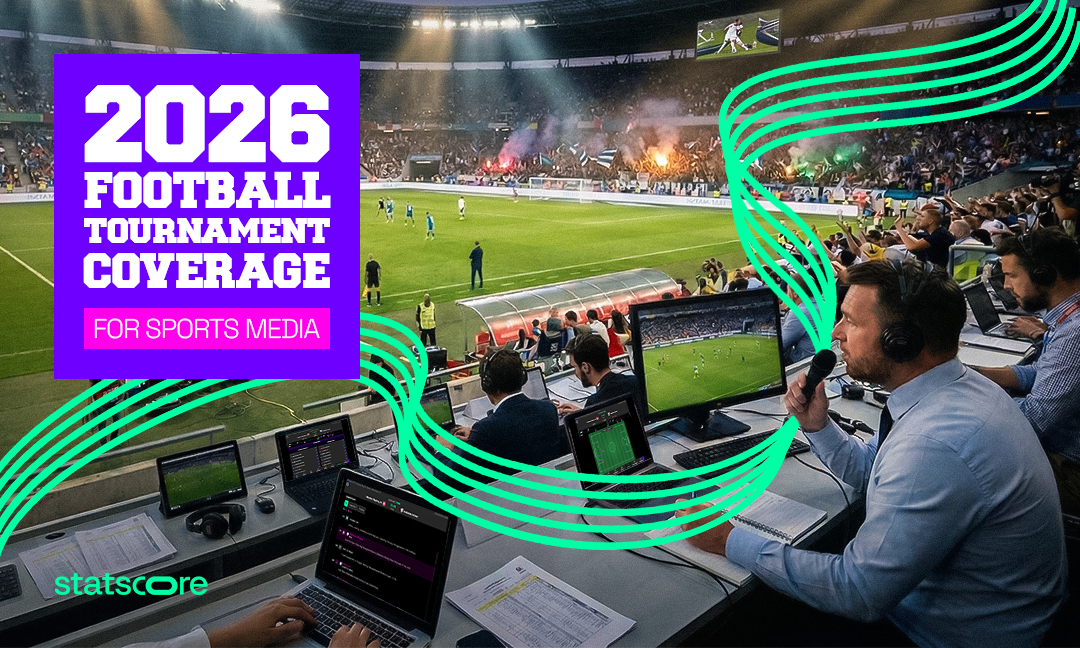
International football tournaments are not “just another sports event” for publishers. They’re predictable traffic spikes that compress weeks of audience demand into a short time window.
That’s good news – but only if your coverage is built to retain users, scale under pressure, and convert attention into revenue. If it isn’t, tournaments become expensive: newsroom overtime, tech fire drills, inconsistent data, and missed monetization opportunities.
This guide explains international football tournament coverage from a media, newsroom, and publisher perspective: what changes on a global scale, where money is made or lost, and which coverage models tend to work.

Why international tournaments are “traffic events” for publishers
From a business standpoint, tournaments behave differently from league seasons:
During major tournaments, demand doesn’t rise steadily – it hits in waves. A matchday can reshape your traffic pattern overnight: users chase context, compare outcomes, and jump between related pages as the story unfolds. In that environment, you’re competing not just with other publishers, but with live social feeds, short-form video, and notifications that can satisfy intent faster than your page loads.
That shift immediately raises the bar. During tournaments, “good enough later” becomes “wrong now.” Slow load times, stale stats, missing details, or thin context create friction that users won’t tolerate. The moment they sense they’ll need to hunt for the full picture, they bounce and get it elsewhere.
The biggest change is behavioral. Tournaments create a habit loop: users return multiple times a day for updates, orientation, and “what this means next.” When return frequency rises, session value rises with it. One extra page view or one extra return visit doesn’t just boost engagement — it multiplies ad impressions, increases sponsor exposure, and improves revenue potential at scale.
A common failure mode is treating tournament coverage as a stream of unrelated articles. It captures clicks but loses users. The more resilient approach is to think in product terms: how do you keep users informed, entertained and engaged throughout the tournament journey?
Football coverage models that work (and when to use them)
Most tournament strategies fall into three practical models. None is perfect. The best choice depends on your site type, resources, and the audience you already have.
1) News-first model
You publish quickly: breaking updates, match reports, reactions, quotes, transfers and controversy-driven angles.
When it works
- Strong newsroom, strong distribution (social/search), fast publishing pipeline
- You can “win the moment” with speed and authority
Where it breaks
- Content becomes scattered
- Users can’t find a single place to follow the tournament
- Monetization suffers because sessions are short, and return visits are inconsistent

2) Live-first model
You invest in real-time formats: live blogs, minute-by-minute pages, quick stat-led updates, and rapid recaps.
When it works
- You already have a strong live infrastructure and consistent data inputs
- You can refresh content frequently without burning your newsroom
Where it breaks
- Manual workflows don’t scale
- Inconsistent stats or slow updates damage credibility
- Performance issues become visible under peak traffic
3) Hub-first model
You build an “everything in one place” tournament section that becomes the navigation spine: match pages, team pages, stats, and editorial highlights.
When it works
- You want a single navigation spine that keeps users oriented during matchdays, reducing bounce and increasing repeat visits.
- You aim to keep users on-site across matchdays and storylines
Where it breaks
- If the hub is only a category page with links, not a product experience
- When updates are slow or incomplete, users leave and don’t return

In practice, the most effective publishers combine hub-first structure with news-first speed and live-first moments. The hub creates continuity; articles create depth; live formats create urgency.
Content formats across the tournament lifecycle (before / during / after)
Tournament coverage isn’t a single phase — it’s a lifecycle. Publishers who treat it as one continuous news stream often end up spending time in the least efficient way: producing a high volume of isolated posts without building a structure that can be reused, refreshed, and monetized across multiple matchdays. A lifecycle mindset forces a better question: what should you publish before the peak hits, what must be delivered during the peak, and what can be converted into durable value after the peak is over?
Before the tournament, your job is to build the runway. This is when you create assets that will keep paying off once matchdays begin, when there’s no time to start from scratch. This is here pre-match and historical context becomes a differentiator: head-to-head history, recent form trends, performance patterns, and matchup-specific angles that make a preview feel useful rather than generic.
When you can consistently surface that kind of pre-match insight, you’re not just “previewing” games – you’re building a habit loop before the tournament even starts, giving audiences reasons to explore multiple pages and come back as the schedule unfolds. The business upside is straightforward: pre-tournament work reduces editorial load during peak days while creating deeper entry points that keep users moving through your coverage.

During the tournament, the priority shifts: win attention, then keep it. Matchdays create demand that is fast, impatient, and often multi-screen. Audiences bounce quickly if your coverage is slow, inconsistent, or hard to navigate, so the formats that perform best are the ones that reduce friction. Live updates matter, but only if they’re reliable. What usually separates strong tournament coverage from noise is context delivered at speed: short “what changed and why it matters” insights, clear explanations of turning points, and data-led micro-narratives that give meaning beyond the score. The common trap is chasing novelty – publishing more disconnected posts – instead of building a clear path through the tournament. Retention beats volume. If users understand where to go next and can find the latest context in seconds, they stay longer, return more often, and generate more monetizable inventory.
After the tournament, you harvest evergreen value and loyalty. This is where you convert short-term spikes into long-term growth. The best post-tournament pieces don’t just summarize; they extract trends, explain what the tournament revealed, and connect outcomes to what happens next. It’s also the moment to refresh and consolidate your strongest evergreen assets so they remain useful beyond the final match, rather than turning into dead pages. From a business angle, post-tournament content is often the bridge to retention products: subscriptions, newsletter growth, and “return next time” habits. You may not get the same peak traffic again immediately, but you can keep the audience you earned – and that’s where the long-term return is made.
Monetization: where publishers win or leak revenue

Tournaments are often treated as a “traffic win”. But traffic is not revenue. Revenue comes from structured attention.
Here’s where publishers typically win:
Win #1: Increasing session depth and return frequency
If users view 1 page and leave, you’re buying attention with newsroom labor and not converting it into meaningful inventory. Tournament hubs and contextual pages can increase pages per session, repeat sessions per day and overall time on site. Those metrics are not vanity – they correlate with real ad delivery and sponsor exposure.
Win #2: Concentrating sponsorship into predictable surfaces
Sponsors want clarity: where will the audience be? Hubs, match pages, team pages, and recurring tournament sections create predictable “surfaces” that are easier to sell than scattered articles.
Even without exclusive rights or official affiliation, publishers can build sponsor-friendly sections that remain clearly independent and editorially controlled.
Win #3: Making “context” the product
The score is everywhere. Context is not.
Context that drives engagement includes:
- trend comparisons (team performance changes)
- “what changed” insights
- visual explanations that reduce cognitive load
When context is missing, the bounce rate rises and monetization leaks.
Where money escapes:
Leak #1: Scattered content with no navigation spine
Users can’t easily find the next relevant page. They go back to search or social. That’s a direct leak in session depth and ad impressions.
Leak #2: Slow or inconsistent information
Late updates and conflicting stats break credibility fast. Once a user distrusts your tournament coverage, they stop returning.
Leak #3: No plan for retention assets
If you don’t convert peak visitors into newsletter/push subscribers, you’re rebuilding the audience from zero each matchday.
A tournament’s business upside depends less on “how many users arrived” and more on whether you built a system that turns arrivals into repeat consumption.
Operational bottlenecks that kill coverage (and revenue)
Tournament coverage tends to expose hidden weaknesses. The bigger the tournament, the less forgiving the system becomes.
Bottleneck 1: Editorial throughput
When volume spikes, you either:
- add people (overtime, freelancers, extra shifts), or
- reduce quality (short, repetitive posts), or
- miss coverage windows
Each option has a cost. The risk is spending more and earning less because the content isn’t structured for retention.
Bottleneck 2: Consistency of information
Manual updates break under pressure:
- numbers get copied incorrectly
- different pages show different facts
- recaps don’t match live pages
That inconsistency is not a “minor bug”. It’s a trust hit – and trust directly affects return frequency.
Bottleneck 3: Product performance under peak traffic
Peak traffic exposes:
- slow templates
- heavy scripts
- unstable live components
- cache or CDN misconfiguration
A small latency increase can be the difference between a user staying and leaving, especially on mobile.
Bottleneck 4: Cross-team coordination
Tournaments force collaboration: editorial, product, ad ops, devops, social, newsletter. If responsibilities are unclear, mistakes multiply and reaction time collapses.
A practical way to think about bottlenecks is simple: anything that prevents you from delivering fast, consistent, navigable coverage is also preventing you from monetizing peak demand.
Treat Tournaments as a Product, Not Just a News Event

International football tournaments are high-stakes opportunities for publishers, but only if coverage is treated as a system rather than a series of isolated articles. Success isn’t measured by clicks alone; it’s measured by retention, session depth, and the ability to convert fleeting attention into sustainable revenue.
The most resilient publishers combine speed, structure, and context: a hub-first foundation that orients users, news-first updates that add depth, and live-first formats that capture urgency. Pre-tournament work builds the runway, matchday execution wins attention, and post-tournament assets lock in long-term value. Along the way, every bottleneck – from editorial throughput to technical performance – must be anticipated and managed, because the cost of failure scales with audience size.
When executed strategically, tournament coverage transforms a temporary traffic spike into lasting audience loyalty, monetizable inventory, and a stronger competitive position. In short, the business of covering international football isn’t about reporting the score; it’s about turning attention into a repeatable, revenue-generating product.