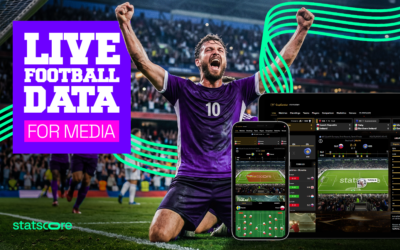
The greatest football event on the planet is almost here. For any sports media desk, that’s both the best and the worst news of the year. Is your business ready for this ultimate show? The traffic is going to be massive. You know it, your advertisers know it, and your...
Monetization & performance in sports media

The traffic spike is guaranteed. Hundreds of millions of football fans, 104 matches, 39 days. What isn’t guaranteed – what most sports publishers get wrong, tournament after tournament – is turning that attention into actual revenue.
Here’s the pattern: traffic editors watch session numbers climb, dashboards light up, and the numbers look extraordinary. Two weeks later, someone calculates what it all actually made. The figure is embarrassingly close to a normal month.
The problem isn’t the audience. The problem is the gap between attention and monetization.
The real competition isn’t other publishers
According to a 2025 IBM survey of 20,000+ sports fans globally, 90% of fans consume sports content beyond just watching live events. And when they reach for a second device during a match, 38% do it specifically to get stats and updates on other games.
That second screen is your competition. Not a rival sports portal – an app that delivers in real-time what your website should have been doing all along.
The behavioral pattern is predictable: before kickoff, fans want context. During the match, they want live data. After the final whistle, they want narrative.
Three distinct audience states, three different session lengths, three different monetization windows. Most coverage operations are built for state one – the article. The two windows where users stay longest and return most often belong to someone else.
Why “good coverage” isn’t enough
The same IBM research shows that 73% of sports fans use mobile sports apps, and the single biggest reason is: all the information in one place. If your platform doesn’t deliver that, fans will find one that does – and they’ll be on it during your tournament.
The editorial cost compounds the problem. Newsrooms that build tournament coverage manually – updating standings, maintaining fixtures, keeping stats current across formats – burn capacity on work that generates zero revenue directly. Every journalist updating a table is a journalist not writing the story that drives search traffic and return visits.
The window is also finite in a way that’s easy to underestimate. Audience habits form in the group stage. Publishers who establish themselves as the destination early keep users through the knockouts. The ones still patching their live coverage infrastructure at the Round of 16 spend the rest of the tournament fighting for second place.
What the architecture that pays looks like
Three elements, working together.
A dedicated destination – not a tag page, not a category archive. A tournament hub that becomes the place fans return to multiple times a day. One consistent experience that answers “what’s happening now” and “what’s coming next” without requiring the user to leave.
Live data that retains. Interactive match centers – real-time stats, key moments, automated commentary, player data – eliminate manual editorial burden while increasing session depth. The IBM data is clear: real-time updates rank as the single highest-priority technology improvement fans want from their sports experience, cited by 35% globally as a high priority. That’s above personalization, above AI insights, above everything else.
Monetization surfaces built in from the start. Sponsor zones, branded gamification, pre-match prediction tools, ad placements tied to live moments. When a user engages with a lineup predictor 90 minutes before kickoff and stays through the match to see how it played out – that’s a session structure that earns. It doesn’t happen by accident.
The urgency goes beyond this tournament. 73% of sports fans expect their consumption habits to change by 2027, driven by demand for live data and real-time digital engagement. The tournament is a concentrated version of a shift already underway.
CupCenter’26: The Tournament Hub Built to Close the Gap
This is exactly the problem CupCenter’26 was designed to solve – not as a widget add-on, but as a complete tournament engagement zone that publishers can deploy in two days and own throughout the entire competition.
The product brings together every element of the architecture described above:
- live match data with real-time stats,
- automated standings and fixture updates,
- player and team profiles,
- live commentary powered by data,
- gamification tools,
- built-in monetization surfaces – all within a single customizable hub that carries your branding.
For a Head of Content, that means editorial teams stop spending time on data maintenance and start spending it on the journalism that drives reach.
For a Digital Product Manager, it means a live match experience that retains users through the 90 minutes instead of losing them to a competitor’s app at kickoff.
For a CEO or CRO looking at the revenue line, it means those monetization surfaces – sponsor zones, branded features, ad placements tied to live moments – are active and earning from match one.
The tournament runs from June through July. Deployment takes two days.
The question isn’t whether CupCenter can be ready for 2026 – it can. The question is whether your coverage will be built to monetize the traffic when it arrives, or whether you’ll spend another summer watching session numbers climb while revenue stays flat.
The Window Is Shorter Than It Looks
The traffic will come. It always does. What changes – what separates publishers who turn this summer into a revenue event from those who treat it as a traffic milestone – is whether the infrastructure to capture that revenue is already in place when the first ball is kicked.
See how CupCenter’26 closes the monetization gap for your platform: statscore.com/cupcenter26
SPECIAL OFFER: Integrate CupCenter’26 and receive LiveCommentary at no extra cost for the full duration of the tournament. The offer is available to new clients who book a demo before June 10!
SEE CUPCENTER’26 IN ACTION – BOOK A 30-MINUTE DEMO!
Related articles
Live football data solutions for media
The greatest football event on the planet is almost here. For any sports media desk, that’s both the best and the worst news of the year. Is your business ready for this ultimate show? The traffic is going to be massive. You know it, your advertisers know it, and your...
Football match centers and widgets: why interactive data is the new standard for fan engagement
The 2026’s greatest football competition has already kicked off; not on the grass of North America, but on the screens of millions of fans worldwide. For sports publishers, the media "pre-season" is over. And the trophy in this specific competition is made of...
The “Zero-Maintenance” Newsroom: how can media effectively cover the world’s top tournament?
The summer of 2026 is approaching fast. For media houses and newsrooms, the upcoming global soccer tournament in North America represents the ultimate opportunity for traffic, but also the ultimate logistical nightmare.With 48 teams, more matches than ever before, and...